
UK Weather Update
- Monday, May 17, 2004
This analysis featured in the May 17, 2004 issue of the HGCA's MI Prospect, Volume 6, Number 23
Key points
- Despite unusual sowing conditions grain yield expectations normal
- Rapeseed crop below what area expansion suggests
- Late harvest could result in early price volatility
The weather and its impact on quality and yield is always of interest in a market context. But, this year the timing of harvest is an added interest. Were the 2004 harvest, particularly that for winter barley, delayed for an unpredicable weather related reason, there would be for a short period a very active market immediately prior to harvest.
This article reviews the impact on 2004 crop development in terms of the weather to date. While it is too early to provide any indication of crop prospects beyond indicating that crop development at this time is normal, the article provides references to two website where crop development can be monitored on an ongoing basis.
Sowing
Sowing conditions in the autumn were certainly unusual. The late summer/early autumn period was particularly dry. Rainfall for August to October for the UK as a whole was less than half normal levels, see graph 1. This created challenges with seed bed preparation and crop establishment for early sown winter crops, particularly oilseed rape.
continue Source: Met Office
continued
The return of more normal rainfall patterns in November allowed for sowing delayed by dry conditions to proceed and for crops that had been seeded earlier to become established satisfactorily. Some oilseed rape crops were an exception to this with a significant area being ploughed up for reseeding in the spring.
The December 1 UK Survey of Agriculture almost 3M hectares of cereals and oilseeds had been sown, 8.6 percent more than in the exceptionally wet autumn of 2002, but only 0.7 percent more than in 2001 when autumn condition were favourable(table 1). While the halving of the CAP set-aside requirement to 5 percent was widely anticipated earlier, it was only formally confirmed by EU in mid December.
Table 1: UK Autumn and Winter Sown Crops,000 hct.
----------------------------------------------
Harvest Wheat  Barley   Oats    OSR     Total
Year
----------------------------------------------
2000    2,087     612     89    310     3,098
2001    1,356     462     71    345     2,234
2002    1,983     546    103    341     2,973
2003    1,751     456     99    423     2,729
2004    1,965     449     86    494     2,994
----------------------------------------------
Source: DEFRA December 1 Survey of Agriculture
This, and the relatively normal rainfall and temperatures in December may have permitted some late seeding of winter wheat. But the opportunity for additional sowing is likely to be reflected more in increased acreages of spring seeded crops.
It would, therefore, seem that weather conditions did not have an adverse effect on actual sowing, although some crops were in poorer than usual conditions going into winter.
January was relatively wet. But with the return of dryer weather in February and particularly March together with warmer than usual temperature during the winter months (Graph 2), sowing of spring crops and the general onset of spring growth was opportune. Conditions in February and March should have enabled any extra crop area encouraged by the reduction in set aside requirement to be sown. But operational considerations including rotational limitations, commitments to industrial crops and environmental programmes are likely to have significantly limited this potential.
continue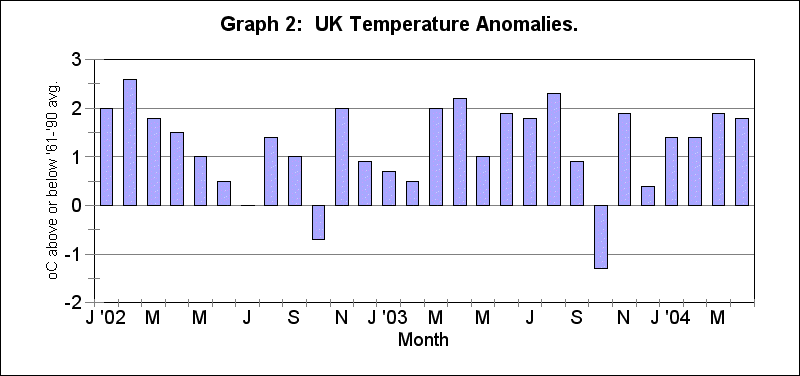 Source: Met Office
continued
The first survey, and therefore definite indication, of cereal and oilseed acreage will be the HGCA's Planting survey, which is published in late June or early July.
continue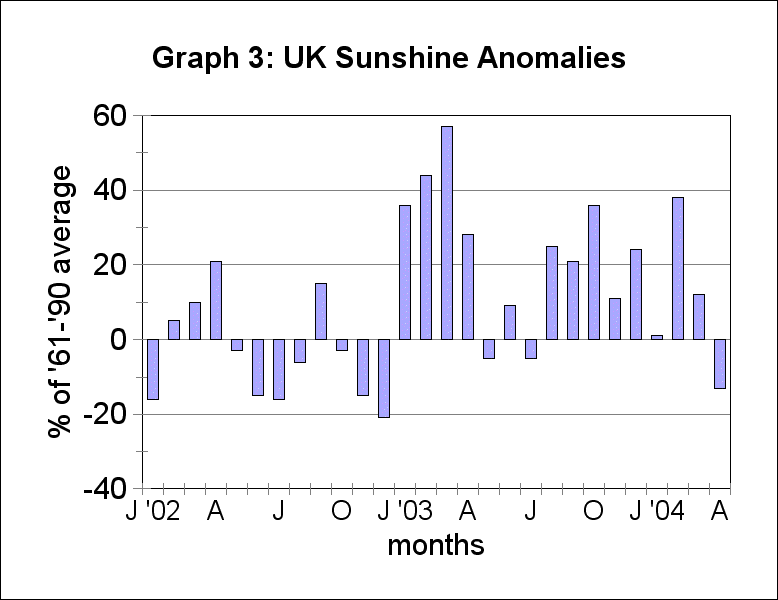 Source: Met Office
continued
Early Crop Development
With the return of relatively wet condition and the continuation of warmer than average temperatures during April and into early May, crops have moved forward well and are generally in the early canopy development stage. DEFRA's Live Monitoring Network (http://www.crop-disease-surveys.com/) indicates that winter wheat crops across England in late April/early May were generally at Growth Stage 31 to 33, which is close to benchmark development.
Yields are ultimately dependent on conditions after Growth Stage 39, during flag leaf and subsequent development, which is still several weeks away for winter wheat. Current crop conditions are such that typical weather developments are likely to result in typical yields.
Reports from the HGCA's Winter Barley Reference Crop project (http://www.hgca.com/bgs/2003-04/ ) suggest that English and Scottish winter barley crops generally reached Growth Stage 31 in mid April ahead of winter wheat crops, as is usual. Winter barley crops are only now approaching the flag leaf emergence stage after which weather conditions become critical. Again the current condition of the crop is not limiting yield potential.
The exception to the generally satisfactory state of autumn sown crops is that for oilseed rape. Crops sown this spring to replace winter crops, which were pulled up due to poor germination resulting from very dry conditions in early autumn, will naturally not yield as well. There may also be, in some areas, crops which in retrospect should have been resown as they are still showing the effect of poor establishment.
Spring sown cereal, mainly barley, which tend to be grown on freer draining soils and which are now generally in the tillering stage have undoubtedly benefited from widespread and substantial rains in late April and early May.
In a general there is currently no reason to expect anything other than a typical cereal harvest this year. It may, however, be advisable to not to anticipate an increase in the oilseed rape harvest based on the 16 percent increase in autumn sowings.
Timing of Harvest
While statistics are presented for the sake of simplicity at a fixed cut off date separating one crop year from the next, July 31/August 1 for the UK, the situation is less clear cut in practice for the UK. The winter barley harvest usually starts in mid July but combines start rolling in south west England before they do else where.
The timing of harvest this year is of more than usual interest as end of season stocks, intervention and otherwise, are expected to be very low. The market naturally works on moving available supplies from one harvest before the next is available. This is particularly the case when current crop year supplies are relative tight and are supporting prices above those anticipated for the new crop harvest.
But everywhere readily available supplies of grain are minimized prior to harvest as farmers sell remaining stocks prior to an anticipated decline in prices after harvest starts and consumers delay buying for the same reason. The reality is, however, that something in the order of 250,000 tonnes of all grains is consumed weekly.
A challenge arises if harvest is late. In reality this is accommodated by some switching of old crop wheat for new crop barley and the "borrowing" at short notice of old crop supplies in later areas to be "repaid" promptly with new crop supplies by the earlier areas. This is, of course, not done without cost which is likely to be reflected in a short lived peak in prices just before a late harvest.
Unfortunately such situation can not be anticipated sufficiently in advance for them to be totally avoided. The timing of the winter barley harvest which is particularly critical in this context is determined very much by crop conditions during the month or so before harvest, with thin crops subject to moisture and heat stress likely maturing early.
Winter barley crops at this time do not seem to be so stressed and current reports indicate a normal crop this year. But clearly their condition needs to be monitored during the next two months to provide an indication of pre harvest market conditions. A late harvest amid tight old crop supplies may create shrp price volatility before new crop becomes available.
David Walker
'phone: 01603 705153
top of page